After a “few months” away :), I thought it might be lovely to pop back in – even just for quick posts – to share a little something for our spiritual reflection.
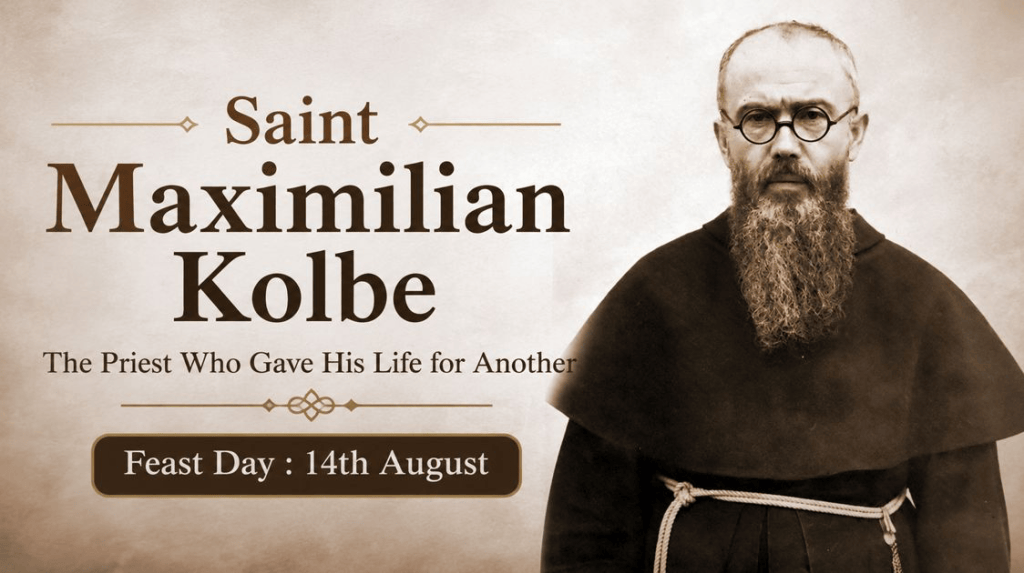
On this ocasion a short post on Saint Maximilian Kolbe.
Maximilian Kolbe lived a short but extraordinarily intense life marked by deep Marian devotion, intellectual brilliance, missionary zeal, and ultimately heroic self‑sacrifice.
Kolbe was born 8 January 1894 in Zduńska Wola, Poland, to a poor but devout Catholic family. As a child he experienced a mystical vision of the Virgin Mary offering him two crowns: one white (meaning he would remain pure) and one red (he woudl be a martyr). He accepted both.
This moment shaped his entire vocation.
He entered the Conventual Franciscan Order in 1907 and later studied philosophy and theology in Rome, where he was ordained a priest in 1918.
In Rome he founded the Militia Immaculatae (Army of the Immaculate) in 1917, a movement dedicated to evangelisation through total consecration to Mary. Returning to Poland, Kolbe became a pioneering Catholic communicator. He launched the magazine Rycerz Niepokalanej (“Knight of the Immaculate”) and in 1927 founded Niepokalanów, a massive Franciscan community and publishing centre that eventually housed around 700 friars, making it one of the largest monasteries in the world at the time.
Kolbe’s missionary zeal took him abroad. In 1930, he travelled to Japan, where he founded a second “City of the Immaculate” near Nagasaki and published a Japanese edition of the magazine. He later attempted to expand to India as well. Despite chronic tuberculosis, he continued to build media apostolates and returned to Poland in 1936 to lead Niepokalanów’s rapid growth, including establishing a radio station.
When World War II began, Kolbe used Niepokalanów as a refuge for displaced people, many of them Jewish. His anti‑Nazi publications drew Gestapo attention. He was first arrested in 1939 and released, but on 17 February 1941 he was arrested again and eventually sent to Auschwitz on 28 May 1941, becoming prisoner 16670. Even in the camp he continued his pastoral ministry, encouraging prisoners and sharing his meagre rations.
In July 1941, after a prisoner escaped, the SS selected ten men to die by starvation. One of them, Franciszek Gajowniczek, cried out for his family. Kolbe stepped forward and volunteered to take his place, an act of charity that stunned even the guards. After nearly two weeks in the starvation bunker, he was killed by lethal injection on 14 August 1941, the vigil of the Assumption of Mary.
Kolbe’s legacy spread worldwide after the war. He was beatified in 1971 and canonised in 1982 by Pope John Paul II as a “Martyr of Charity.” Today he is venerated as the patron saint of prisoners, families, journalists, and people struggling with addiction.
His motto, “Only love creates,” captures the radical self‑giving that defined his life.
Several moments in Kolbe’s remarkable life stand out. His devotion to Our Lady and his drive to spread full dedication to Mary reflect his energy and capacity for work. His absolute faith in the Blessed Mother as a path to Christ shows great strength, yet his serenity is more striking. If you read any of Kolbe’s biographies, you will see that during his many dark moments he always trusted. He had a mission and calmly accepted it, even surrendering his life for another person. A martyrdom understood not merely as dying for Christ under religious persecution, but dying like Christ. An act of self-giving love, drawing on Jesus words in the Gospel of John.
In Saint John Paul II’s own words on the occasion of Kolbe’s canonization:
“No one has greater love than this: to lay down one’s life for one’s friends” (Jn 15:13). From today onward, the Church wishes to call Saint a man who was granted the grace to fulfil these words of the Redeemer in an absolutely literal way.“
My recomendation BOOKS if you want to learn more on Max. Kolbe:
A Man for others – Patricia Treece – link to the book on amazon.co.uk (I get no money with the sale of any books)
St. Maximilian Kolbe – Fr. Peter Damian Fehlner – link to the book
The Theologian of Auschwitz – link to the book


Leave a comment